
• Book Review: Mentoring
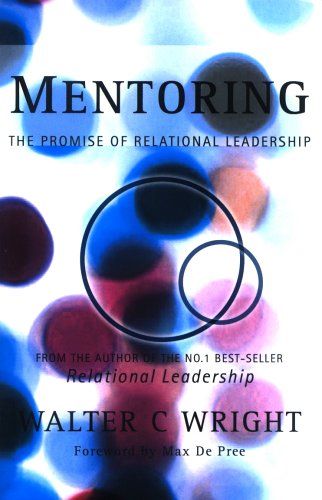
Mentoring: The Promise of Relational Leadership
By Walter C. Wright Jr., Paternoster Press, 2006, 160 pages
Mentoring is a legacy book, a work of a life of being mentored and a life of giving back. This work of mentoring is all about relationship and accountability. For those without a mentor, this volume might just push you into considering such a new adventure of lifelong reciprocal learning.
Here Walter Wright shares some of his priceless insights and deep experience both as a mentoree and a mentor. For me this work highlighted the processes that I myself have experienced in working with others. Further, it challenged and encouraged me to plunge deeper into mentoring waters.
His vulnerability in unpacking sixty years of mentoring experience was inspirational, including the ups and downs of the adventure. I especially liked his account of the Sherpas or guides who come alongside mountain climbers in Nepal to assist in the adventure to the top. The role of the rope clarified the relational process that mentoring is all about.
I recommend this book for those who have no mentor and for those who have one. It will clarify the mentoring relationship and explain how the mentoring process can work to enhance the journey. We do not have to go it alone.
• The Role of Inclusion

The Role of Inclusion
We believe that all are created equal and that all should be offered the benefits of salvation in the economy of God. Our relationship with Jesus extends to all. All are included, there is room for all, but it is also true, that not all will respond. However, those who do respond should not be marginalized. That means that all who respond can be included, regardless of gender, class, ethnicity, rank or status, rich or poor, even those which physical disabilities are included.
However, when we only respond to those who are like us, we, by this response, leave many in our society out. Therefore, they are candidates to be marginalized by our faith community and are not included, by default.
In considering the implications of this role of inclusion, it might be argued that it would be easy to ignore or not make any provision in our ministries for children who might be left out of our relational program. Often, I think we wait for marginalized children to come to us, then we since some need to create a program for them. However, what if we planned to include some by design? It just might upset the apple cart of the most comfortable among us.
The “homogeneous unit” principle states that we tend to attract people to our fellowship who are the most like us. This is the role of inclusion, but by this concentration some are omitted and are therefore candidates for being marginalized, or left out, if you please.
But when we read about the ministry of Jesus we observe just how He included the marginalized in His day—rich, poor, prostitute, centurion, tax collector, paralytic, blind, deaf, demon possessed, Samaritans, other Gentiles. All of these might be considered marginalized from the Jewish community in that day.
Here are a few possible categories of marginalized children that might be candidates for inclusion in your ministry.
• Measuring Kidmin Success

Measuring Kidmin Success
There seems to be some confusion about what constitutes Success for the Children’s Minister. We all think about it. We want to be successful at what we do and be known for that success. I think part of this confusion comes from our American culture, which basically says…Success has to do with superlatives—biggest newest facility, increased numbers, more salary, bigger team, greater budget, better quality and grander quantity of resources, etc.
But for the Kidmin, success is really about our leadership—faithfully serving God, being a contributing team player with the staff, knowing kid’s culture, following the vision from God, being good stewards of resources, equipping and training volunteer leaders, reaching out to those without Christ and discipling children to be faithful followers of Jesus, empowering parents to be the spiritual leaders of their own children and trusting God to use us in a mighty way to expand His Kingdom. However, at the end of the day, we value that God just shows up in a powerful way in our ministries. It is all about a demonstration of God’s power. Can we take any credit for any of that?
Here are My Baker’s Dozen Indicators for Measuring Kidmin Success.
• A Good Business Decision?
 A Good Business Decision?
A good business decision is not always understood to be good until time has elapsed and the evaluation is done. Business’s are in the business to make money, so one of the best ways to measure a good business decision is to realize a profit. However, most good business decisions are calculated with an element of risk. The marketplace does not always perform the way we might expect or predict. There can be some surprises, some hidden factors or some unforeseen variables that might alter the bottom line and the profit anticipated. It is important that there is a projected return on investment. (ROI)
In Church Ministry we are not always looking to the bottom-line as the litmus test for making good business decisions. We are more concerned about converts, baptisms, changed lives, membership, programs, and tithers. ( to name a few)
In Children’s Ministry we might want to focus on making good investments with our budget, getting deals on our resources. Arranging for a speaker that fits your budget, or investing a potential nuclear family that has leadership potential and could assist in the growth of the church. When leaders come together to hire a Children’s Pastor they are looking for someone who will make a significant contribution to the growth and development of the church.
They would consider it a bad business decision to hire a baby sitter, or a person to provide childcare. They also do not want a maintainer, but a purpose-driven leader who can not only lead a volunteer team, provide new cutting-edge programming, but also can be a team-player on staff. The goal is not to maintain the status quo or manage the complaint department. So a good business decision is much more complex than the bottom line, like in business. But could it be said that your church is making good business decisions in ministry? How about in your Children’s ministry?
So here are a few Case Scenarios that might call for a good business decision. What would be your best response—that might be classified as a good business decision? Think about it!
• Photo Challenge: Week Four
Summer Photographic Challenge: Week Three
It has been fun to press in on learning more about photography and my camera. Here are the four shots I submitted this last week.

Artie, the Artichoke
Artie, the Artichoke is front and center. Displayed with his Kin, this family shot is such a study of composition with light focused on Artie. You must know, Artie has gone to the pot, cooked with a hint of lemon and a splash of salt, boiled to perfection. Artie, has a good heart! Yummers!
There are three more shots, if you are interested…
• Best Gift for Father’s Day

Best Gift for Father’s Day
I got a call from Spencer, my four-year old grandson, who lives in Baltimore. “I have something to tell you Papa! Oh what is that Spencer? I asked Jesus into my life today! Whoa, Spencer that is wonderful. Did Daddy pray with you? “Yah, he did.” So Spencer where is Jesus now? He paused (as if the say Don’t you know?) “Inside my life!”
Well, that made my Father’s Day, and my son Ken’s Father’s Day too. Now he has his own Born Again Birthday Book.
That makes four grand kids making decisions at age four—two more to go!
• Check List for A Better VBS

VBS Checklist: A Tool for a Better VBS
The annual routine of doing VBS has an Upside…doing it BETTER than the years before. The more years of VBS experience you get, the more real improvements you should be making in your program and leadership. Here is my new VBS Checklist that could help you to rate your progress over last year?
Obviously, this is not all the evaluation possible, but this might prime-the-pump to get it started. Maybe, you can add to this checklist. Together, we could make it better—a Better VBS.
• Shoot the Story Shot

Shoot the Story Shot
This Summer I enter a Photo Challenge to see if I could improve my ability with my camera. So I am taking the camera with me a bit more and looking for opportunities to spot the shots and shoot the story shots. So on Father’s Day my family stumbled onto a Antique Car Show in Pasadena. They closed a street off and the cars of all sorts were put on display to the public. There were camera buffs galore capturing angles and colors of these incredible restored vintage cars. So my daughter and I joined the crowds, with cameras in hand, looking for something we could capture for our Photo Challenge. Well, I found many shots, but could not enter them all, even some of the really nice ones. So I thought I might show a few here, in case anyone is interested in what I found. Unlike a lot of men I know, I have never been overly involved in an obsessive way about cars. However, just taking pictures of these historic restored vehicles, I sure could understand how some men might get passionate for restoration and the resultant desire to display their classic cars.

Initially, I was attracted to this antique replica car because the exterior brake on the outside of the car. However, trying to capture brake and the red interior with the white exterior, I snapped this photo. Later, at home I noticed all the trophies and awards in the seat that the owner had won with his antique car. Hence, the name… the Prized Brake Mobile.
• Co-Active Coaching Quotes

Co-Active Coaching Quotes:
The following quotes from “Co-Active Coaching,” a book written by the founders of The Coaches Training Institute, eloquently describe what coaching is and how it provides a powerful change process for people.
1. “Imagine a relationship where the total focus is on you, on what you want in your life, and on what will help you achieve it. The coaching relationship is like that.”
2. “Imagine a relationship with someone who is totally curious about your dreams and aspirations, what makes you tick, what you value, what you are most passionate about in your life—a person who will help you clarify your goals and provide the tools for action and learning that lead to the results you want.”
3. “Imagine a relationship with someone who will absolutely tell you the truth—the truth about where you are strong, for example, and where you sell yourself short—someone who knows you can handle it and knows that’s what you want. Someone who sees how big you can be and constantly holds that big image for you—even when you can’t hold it for yourself.”
4. “Imagine someone who listens to you without judgment and allows you to show emotion—in fact, accepts you without analyzing you. Imagine you get to talk to this person every week, even when you’ve just made a mess of things or when you’ve had great success. This is the place you visit regularly and consistently—to consolidate, to integrate, and to push on.”
There are Eleven more….
• My Water Pebble Collection

My Water Pebble Collection
I was ready to leave for Church on Sunday morning and I went to get into my car. I observed these really prominent water drops on the sunroof window of my new Honda CR-V parked in the driveway. Apparently, the unusual light rain during the night left this water residue on the new wax job. It occurred to me that if I drove away, this water deposit would disappear and this photo opportunity would be gone. It could months before Los Angeles might have another such light rain. It was overcast, about 9 am, no bright sun, ambient light. So I quickly decided to grab my Nikon camera to see if I could capture this amazing collection of water pebbles. This is what I got, Cool, but I was late for church. (I entered this photo in the summer photo challenge)